



Cavities

Why Can’t Dentists Cure Cavities or Regrow Enamel?

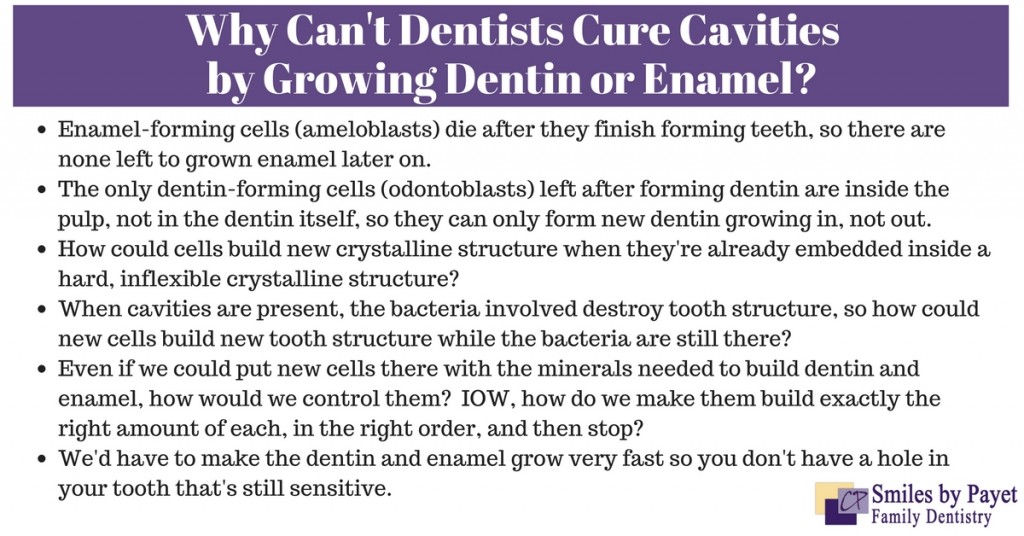
I've previously discussed why you can't cure cavities, but recent research sounds promising, so it's a good time to review.  In addition, there were some good points raised in the comments of the previous article that deserve more attention.  Be warned: lots of bullet lists ahead as I break it down.  :-D Recap: Why We Currently Can't Grow Dentin or Enamel A small-looking cavity that was actually quite big, cleaned out with a laser and filled with composite resin. You can't cure cavities like this. Let's briefly summarise the difficulties that must be overcome in order to cure cavities, whether naturally or artificially: Once the cells that form dentin (odontoblasts) and enamel (ameloblasts) finish forming teeth, they die.  Some odontoblasts remain in the tooth pulp, but they are stuck inside and can't get out. We currently have no way to grow and transfer dentin- or enamel-forming cells into a tooth with a cavity and survive, much less grow new tooth structure. The dentin-forming cells in the pulp can't grow outwards, just inwards, which shrinks the pulp chamber.  This is a normal response to stress from cavities, bruxism, trauma, and aging. If you already have a cavity, we still have to get rid of the bacteria, which usually means drilling out the infected tooth structure. If we don't want to drill, but just put a miracle gel on the tooth, it has to do 3 things: Stay in place for a long enough time to strengthen the enamel and soak way in for deep cavities It has to kill the bacteria inside the cavity It can't negatively affect the rest of your mouth. If we have to drill out the cavity, then place the miracle gel, we still [...]
“If You Don’t Floss, You’ll Die,” Says One Charlotte Dentist

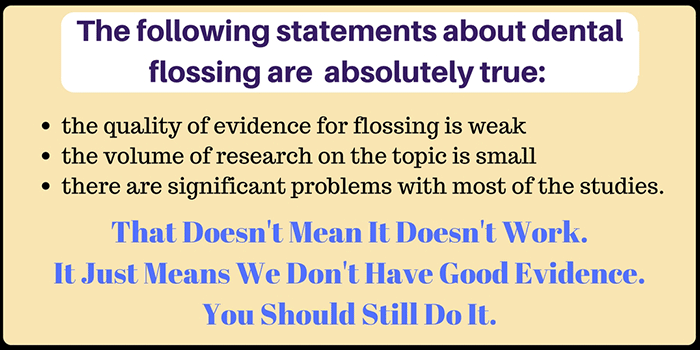
Oh ok, sue me for the clickbait headline....you'll die if you do floss, too.  :-D The Story: Does Flossing Even Work? Obviously, since I'm a dentist and have many dentists friends, one of the most commonly shared and widely discussed news stories this week has been about whether or not flossing is any good for you.  Naturally, because science journalists need traffic for their websites, too, there have been plenty of outrageous headlines: It all started with this Associated Press story: Medical Benefits of Floss Unproven Wait, Does Dental Floss Even Work? (Gizmodo) No Need to Floss, US Health Department Says (NY Daily News) Feeling Guilty about Not Flossing? Maybe There's No Need (The NY Times) And naturally, just as I've discussed in a number of other articles over the years, the science journalists have taken a story about the weak scientific evidence for flossing and suddenly turned it into "OMG FLOSSING IS USELESS!! DENTISTS HAVE BEEN LYING TO US FOR DECADES!!!!"       Ummmmm........no. Just......no.  /facepalm/       The Real Story: There Truly Isn't Much Good Research So here's the crux of the story as quoted from the Associated Press report that set the storm in motion: The AP looked at the most rigorous research conducted over the past decade, focusing on 25 studies that generally compared the use of a toothbrush with the combination of toothbrushes and floss. The findings? The evidence for flossing is "weak, very unreliable," of "very low" quality, and carries "a moderate to large potential for bias." Let me be perfectly up front and honest here, because I have to be, given how much I've harped on the importance of critically evaluating and understanding scientific research and [...]

By | 2017-06-09T20:28:43-04:00 August 3rd, 2016|Cavities, Gingivitis, Taking Care of Your Teeth|0 Comments

Dental Cavities: How Fast Can They Grow?

How fast dental cavities grow may sound like a simple question, but it's actually rather complicated.  I decided to write about it, though, after seeing a patient recently to treat a cavity that went from just beginning to an almost-root-canal-sized cavity in just 14 months.  It's a good example of why most dentists still recommend dental bitewing x-rays every 12-18 months. Is the Cavity There or Not? Here's the starting x-ray, taken on Dec. 14, 2014.  If you look at the circled area, it looks fairly normal.  Unfortunately, there was a slight overlap of the teeth in the x-ray, as the digital sensor was angled ever-so-slightly, and the overlap may have masked the area of concern, preventing an earlier diagnosis.  Since the patient had few fillings, though, indicated a low risk of cavities overall, we didn't retake the x-ray to avoid unnecessary exposure.  Nevertheless, there's really nothing there that caused me any concern. 14 Months Later, the Cavity is Obvious & Deep Check out the circled area this time, eh?  I've outlined the nerve chamber in the tooth on the x-ray in red and the cavity in green, but it's important to know that a cavity is never sharply defined like this.  There are several zones identifiable in cavities, highlighted in the next image.  We also know that cavities are typically about 20-30% bigger than can be seen on an x-ray, which is due to 2 reasons: The human eye can only distinguish about 60% of the shades of grey as a computer monitor can project, so there is simply detail that the eye can't detect, and The deepest zone of decay has not yet softened enough to be less dense enough for x-rays to detect it, [...]

More Bad Journalism on Fluoride

  To paraphrase Britney Spears (my apologies to all), “Ooops, [Newsweek] Did It Again.” Oh yes, sadly, they did - their fearless and misinformed journalist Douglas Main has jumped into the proverbial fluoridated waters and misinterpreted yet another study about fluoride effectiveness. He had a bit of help this time, however, in that the article found here is actually based on a Cochrane Review from the Cochrane Collaboration, generally considered to be one of the best sources of systematic reviews of the scientific literature on a particular topic. This time….not so much. That’s not to say that the Review is bad, per say, but there are some significant weaknesses that Main conveniently ignores while overstating the minimal conclusions that can realistically be made. Starting with Previous Bad and Debunked Claims Main starts by referencing several of his own previous articles in Newsweek relating to studies that purportedly link Community Water Fluoridation (CWF) to ADHD, underactive thyroid, and endocrine (hormone) disruption. Referencing your own journalism is not considered kosher in the scientific literature and does nothing to support your claims, but when those articles and studies have already been shown to be fundamentally flawed, he’s really starting off poorly. The study and related article about an alleged link between ADHD and CWF has been thoroughly debunked here, here, and in my own rebuttal here. The claims of an alleged link between CWF and underactive thyroid have been discussed here and here. Strike 1 for Main As is typical, anti-fluoridationists do a good job of misstating and misrepresenting science that doesn’t necessarily agree with them in order either (1) make the science itself look bad, or (2) make it look as if the science supports them when [...]

By | 2017-06-09T20:29:19-04:00 July 25th, 2015|Cavities, Taking Care of Your Teeth|0 Comments

Juicing, Fruit Juices, & Energy Drinks: Worse than Soda?

Back on December 1st 2014, Forbes.com published an article on a study with the headline: Pure Juice Won’t Rot Your Kids’ Teeth. It didn’t get a lot of attention, thank goodness, because while the article was factual, it significantly overstated the conclusion, much like the 2015 Newsweek article claiming a non-existent link between fluoride and ADHD, which I recently debunked.  Since I’ve been reading a lot of claims on social media that fruit juices, juicing, and energy drinks are healthier for you and your teeth than sodas, this seemed a good time to continue my series on science in medicine and dentistry.  It also follows nicely on my recent article Why I Don’t Buy Organic because it emphasizes why I’m skeptical about all kinds of fads.   To be clear – I have nothing against juicing, 100% juice, organic juice, whatever kind of juice if you like it.  You just need to be aware of potential risks associated with juicing, 100% juice, or energy drinks.  As reassurance, at the end of this article, I provide recommendations on how to best avoid cavities and acid erosion of your teeth if you like juicing. […]

Just How Bad are Sodas for Your Teeth?

MOST people know by know that sodas are bad for you. Not as many people know that diet sodas are just about as bad as regular sodas, simply because of how acidic sodas are. Yes - sugar is bad for your teeth, but acidity is even worse, and when you combine sugar and acidity, you're talking Tooth Decay Bonanza!  I just recently came across this really awesome infographic that spells out for you just how bad it is.  Check it out, and at the end, I've included several links to previous articles about how to prevent cavities, repair early cavities, and some suggestions on recommended products to keep your mouth healthy.   For more information on "soft teeth," how to prevent cavities, choosing dental products, and more, check out the following articles: There's No Such Thing as Soft Teeth How to Reduce or Prevent Cavities Think the Dentist is Expensive?  Then Brush and Floss! My Baby Stole the Calcium from My Teeth What Does Heartburn Have to Do with Cavities? To make an appointment: Request an Appointment Online or call us at 704-364-7069. We'll look forward to meeting you soon!

Do Dental Cavities Always Hurt?

One of the most common questions we hear, when we first have to give a patient the bad news that they have 1 or more cavities is, "But doc, how come it doesn't hurt?" It's a common misconception that a cavity will always give you a toothache. Cavities  Don't Hurt Until It's BAD Today yielded another perfect example of this analogy.  A young lady was diagnosed as having a cavity, not because it hurt, but because I could see the previous silver amalgam dental filling had broken, and because we could see it on the x-ray, as shown. Looking just at the x-ray, you wouldn't suspect how deep the cavity really is.  In fact, studies show that cavities are usually 30% WORSE than they appear on x-rays, because the human eye can not perceive the grayscale changes at the level they really are. What Does a Cavity Look Like? If you'll follow the progression of photos below (and BTW -- this work was done by me, not someone else!), you can see where we started with what was a small old filling, then as we progressively and very carefully removed the decay while using 8-12x magnification with a dental operating microscope, to see just how deep the cavity really was.  The blue stains are from a solution that we use to help us see where the decay is (it stains the cavity-causing bacteria if there are high enough numbers).  Then you can see the finished result: a beautifully natural-looking, tooth-colored composite dental filling. If you are concerned about tooth cavities, Request an Appoint­ment Online or call us at 704–364-7069. We’ll look for­ward to meet­ing you soon!

By | 2017-06-09T20:33:32-04:00 January 11th, 2014|Cavities, Family dentistry|0 Comments

Can Cavities Be Cured?

I’ve seen a lot of posts and articles recently about whether or not dental cavities can be “cured,” with various holistic dentistry advocates pushing alleged cures such as colloidal silver, coconut oil, and some other stuff.  We don’t see many people in our practice with these questions, but since it’s out there, I think it wise to address the issue head-on.  Bear in mind – this article will pull no punches and might seem a bit offensive.  My apologies in advance, but I am definitely getting on my soapbox here.  🙂 Update: I’ve written a new article that discusses the research that is asked about in the comments.  There are ongoing studies into how to stimulate tooth growth with lasers, create gels of minerals and enzymes that could build new enamel, and more.  As of 2016, however, any such research is at least a decade away from being available.  You can read more here: Why Dentists Can’t Cure Cavities or Regrow Enamel. Holistic Dentistry Is a Scam and Hoax No sense in beating around the bush, eh?  I’ll just get straight to the point and give you what I honestly believe, and tell you that there is virtually nothing espoused by “holistic” dentists that has ever been proven to be worth more than the paper it was printed on or the Internet space it took up.  This holds true for the idea of “curing tooth decay,” too, as espoused on such junk “science” sites as NaturalNews.com or WellnessMama.com.  Plain and simple, it’s true that Holistic, Alternative Medicine is Usually Wrong. But getting specifically to the question about “curing” dental cavities, this post was largely inspired by this wonderfully thorough article that debunks the idea of [...]

By | 2017-06-09T20:33:43-04:00 November 24th, 2013|Cavities, Holistic dentist, Taking Care of Your Teeth|0 Comments

The Cavity in the Mirror May Be Bigger Than It Appears

You know that little message in the passenger-side mirror on all cars?  The one that says, “Objects in the Mirror May Be Closer Than They Appear?”  It’s basically saying – objects in the mirror ARE closer than they appear, so BE CAREFUL!  Well, it would be really nice if patients could understand that when dentists say, “There’s a cavity in your tooth,” they’re really saying, “That cavity in your tooth may not look big, but I promise – it’s bigger than it looks!” […]

By | 2017-06-09T20:33:52-04:00 June 10th, 2013|Cavities, Taking Care of Your Teeth|0 Comments

Cavities Don’t Always Hurt

One of the most frustrating things that dentists have to deal with on an every day basis is this very simple question: "But Dr. Payet, how can I have a cavity when nothing hurts?!" And you know what?  The very simple fact is this: Cavities don't always hurt - at least, not until they are REALLY bad, in which case you've waited too long!   When Do Dental Cavities Hurt? I think there is 1 other disease that is a good comparison when answering this question, so ponder this for a moment: When does high blood pressure hurt?  Not until the heart attack usually.  That's the problem we face with cavities.....they usually don't hurt until it's gotten really bad.  Just like with high blood pressure and heart attacks. In dental terms, "really bad" typically means something like teeth being really loose, infected nerves, bleeding gums, broken teeth, etc.  And "really bad" in dental terms also usually means "really expensive."  And PLEASE trust me when I tell you - the huge majority of dentists do NOT want you to wait until things are really bad and really expensive! This Deep Tooth Cavity Wasn't Hurting Here's an example from today - a patient who's been coming to us for about 2 years, but who has an extremely busy work schedule and unpredictable work hours.  When she was in for a cleaning, we had some open time and managed to get a couple fillings done.....and boy were they deep!  We originally planned these almost 2 years ago, and they were a lot smaller then.   Don't Wait Until the Cavity Hurts So what's the point?  Just this: if your dentist tells you that there are cavities, please don't [...]

By | 2017-06-09T20:34:34-04:00 February 26th, 2013|Cavities|0 Comments