



Taking Care of Your Teeth

Why is Oil Pulling a Waste of Time?

It simply astounds me how blindly people accept "natural" remedies without any proof except personal testimonials, all while they proclaim that "real science" has been co-opted by greedy individuals and companies. The current fad of "Oil Pulling" is certainly one of the biggest examples of snake oil holistic mumbo-jumbo quackery to grace the surface of our planet.  Why?  Because it's JUNK, people!  And if there's one thing that really ticks me off, it's JUNK MEDICINE and JUNK SCIENCE. Coconut Oil is Just Fat, People! That's it.  Right there.  That's the reason that oil pulling can not "heal" or reverse cavities, why it can't whiten your teeth, and why it can't cure gum disease.  Because IT'S JUST FAT! When analysed, here's what's in coconut oil: Got that?  It's mostly saturated fats with a little bit of unsaturated fats and a little bit of other stuff.  If you look at the link above, there's also a comparison with other types of oils, and the only one with a higher saturated fat content is cottonseed oil. Now, would someone who believes that coconut oil is a miracle solution for the mouth tell me how all that miracle stuff is done by FAT?  Because fat does not kill bacteria.  It doesn't harden enamel.  It doesn't get down under the gums and get rid of tartar (calculus).  So please...explain how it "cures" cavities or gum disease.  I'm waiting, but I won't hold my breath. Claims of "Toxins" Being "Pulled Out" There is no known process by which fats "pull" so-called toxins out of your body, but that's the claim that gets made.  So why can't people explain how that's supposed to happen?  I mean, if you're going to make that [...]
Does Gum Disease Cause Heart Attacks & Strokes?

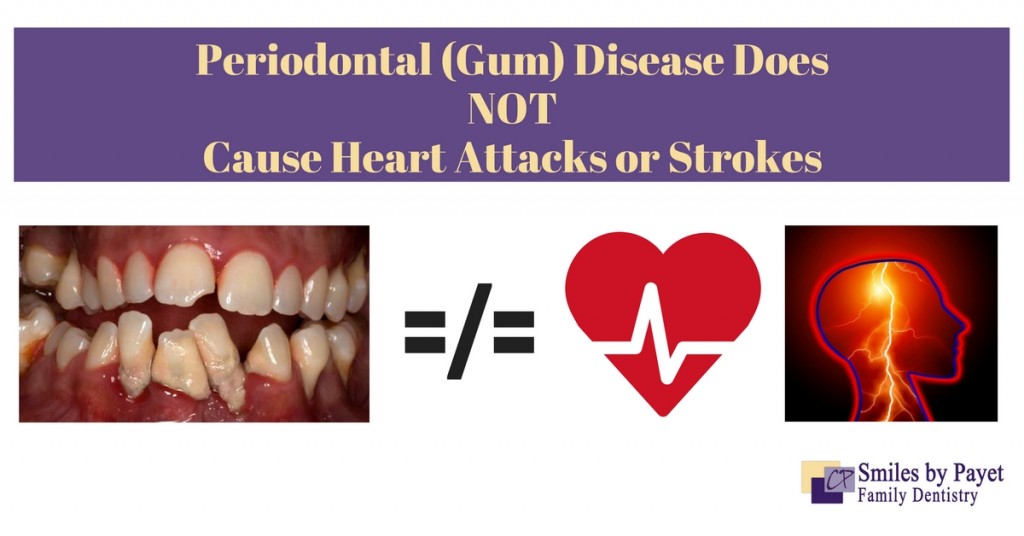
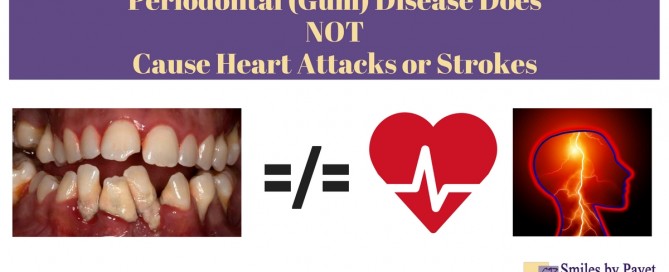
I was recently reminded of claims that periodontal disease is associated with medical conditions like heart attacks, strokes, pre-term births, and diabetes.  Yes, there is an association among those conditions, that's true.  However, some dentists and hygienists try to scare patients into treatment by claiming that gum disease actually causes those conditions.  That's simply not true! One of the most recent articles touching on this touchy subject was by Dr. Chris Kammer, titled “Your Gums are a Cesspool of Infection...and Most Dentists Don’t Care!” as a blog article for the American Academy for Oral Systemic Health; an organization that he coincidentally co-founded in 2010.  The entire purpose of this organization, incidentally, is based on the idea that oral disease (primarily periodontal disease) has significant links to disease in the rest of the body. This link between the oral cavity and the rest of the body was first hypothesized and published in 1989 in two Scandinavian reports (Mattila et al in the BMJ, and Syrjanen et al in the J. Inter. Med) and studies continue to this day.  To this day, however, the results are simply not strong enough to make claims about causality. Correlation Still Doesn't Equal Causation Just as I've criticized holistic and alternative medicine and dentistry as junk, it's crucial that dentists be honest about the level of evidence for anything that we recommend - even flossing!  When we see things that seem to be connected, like gum disease seems to be connected with heart attacks and strokes, we have to ask: is it correlation (coincidental), or is it actually causal (one thing directly leads to the other).  Yes, there seems to be a strong correlation between gum disease and heart attacks and strokes, [...]

Cavities are Not Inevitable

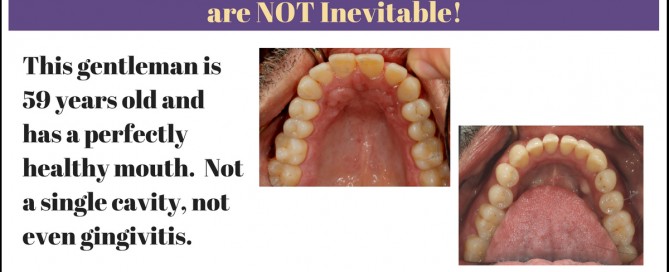
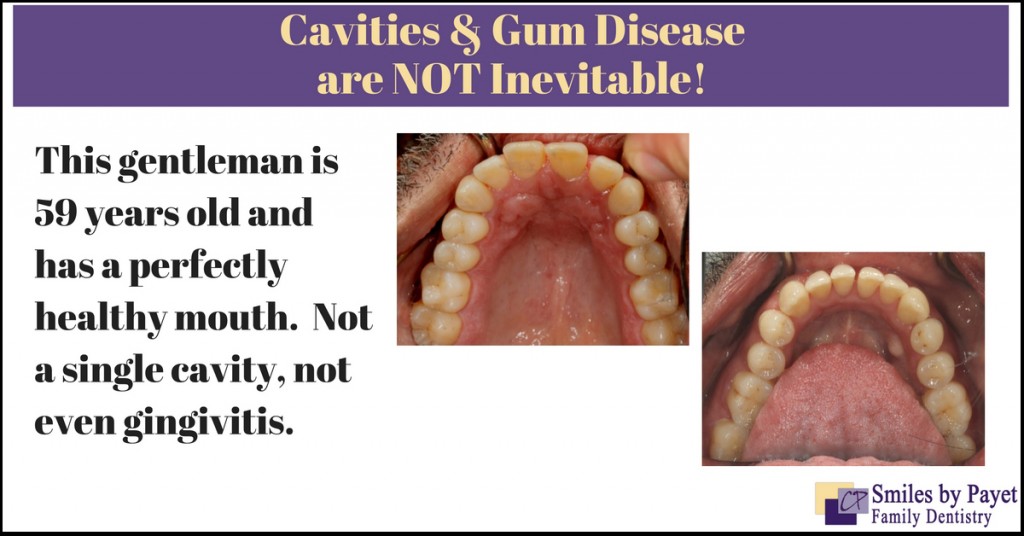
Most people assume that certain things are inevitable as we age, including common dental problems like gum recession, gum (periodontal) disease, or cavities.  However, none of these conditions are as certain as the old adage, "the only guarantees in life are death and taxes," as proven by a gentleman who came to see us recently. 59 Years Old with No Tooth Decay or Gum Disease Richard came to see us as a new patient in early May 2016.  Before I met him, our hygienist Amber said that he had a perfectly healthy mouth, which naturally was a bit of a surprise.  It's true that you aren't guaranteed to have dental problems by 59 years old, but most people certainly do.  Upon looking in his mouth, however, I realized that Amber was correct!  He has never had a cavity, has no gum disease or gingivitis, no gum recession, and only a few crooked teeth.  His bite fits reasonably well, he has a small amount of wear showing on the chewing surfaces, and that's it.  WOW! In our office, he set a new record for making it the longest in life with such superb dental health by a long shot.  The previous best was a 43 year old man who, as far as he could remember, had only been to see a dentist 1-2 times in his whole life.  But 59 years old is a heck of alot longer than 43, that's for sure. Obviously, I couldn't tell him that he'd better come back every 6 months to stay healthy!  LOL  :-D   Since most people don't make it quite this long, if you're at all concerned about cavities, gum disease, or improving your smile, please give us a call for [...]

By | 2017-06-09T20:28:30-04:00 September 6th, 2016|Taking Care of Your Teeth|0 Comments

I Didn’t Know Squat about Cancer

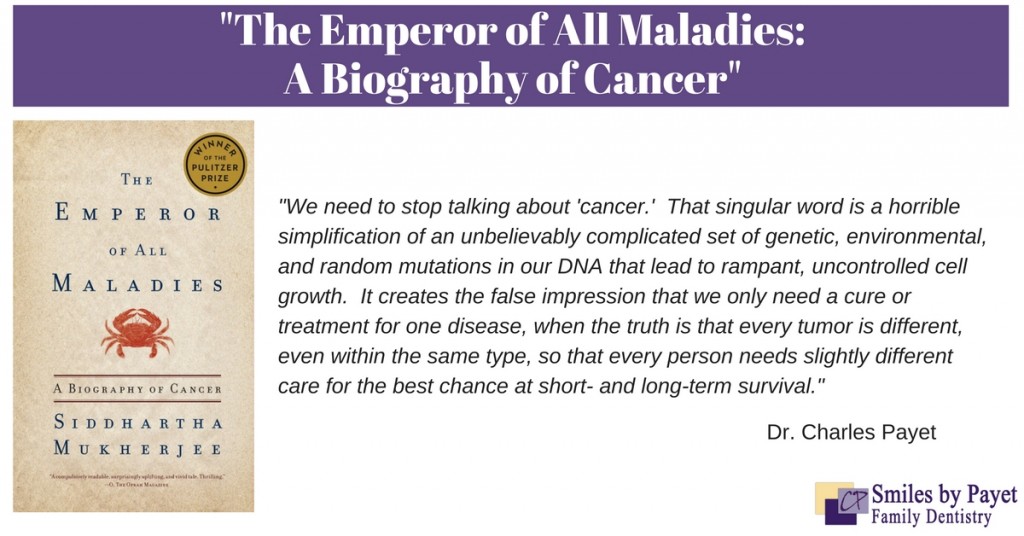
Cancer (in general) and oral cancer were certainly topics that I learned about in our medical/dental training 18 years ago, but after reading The Emperor of All Maladies: A Biography of Cancer by Dr. Siddhartha Mukherjee, I realized just how little I actually knew.  To tell the truth, after reading the book, I now have a mere glimpse into the complex set of 100+ diseases that we call cancer. A quick reassurance: this article does NOT contain any gross pictures that might upset readers. The History of Cancer as a Readable Story   I first learned of this book as recommended reading on the Rationally Speaking podcast sometime in 2016, and I picked it up at Barnes & Noble , along with Dr. Mukherjee's newer book The Gene: an Intimate History, which I'm now starting.  I've been interested in the topic of cancer for a couple years from being involved with the Skeptical movement that debunks pseudoscience and quackery in dentistry and medicine.  Sadly, there is a lot of woo and pseudo-medicine around cancer for many reasons, and I'll address those towards the end of this article. The book, published in 2011, won the Pulitzer Prize (among many other awards) and was made into a PBS mini-series, which I haven't watched yet; it's supposed to be quite good.  The easiest way to sum it up (for those who prefer the tl;dr version) is quoted here from the back of the paperback edition: The Emperor of All Maladies is a magnificent, profoundly humane "biography" of cancer - from its first documented appearances thousands of years ago through the epic battles in the twentieth century to cure, control, and conquer it to a radical new understanding of its essence. The story of cancer [...]

By | 2017-06-09T20:28:37-04:00 August 22nd, 2016|Oral Cancer, Taking Care of Your Teeth|0 Comments

Why Can’t Dentists Cure Cavities or Regrow Enamel?

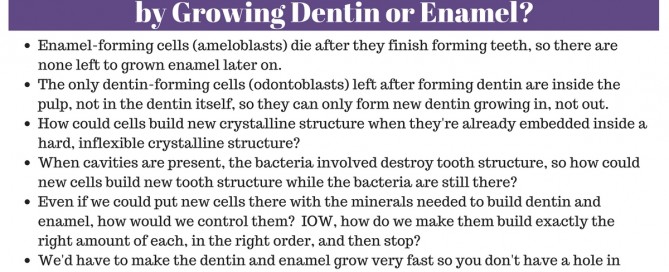
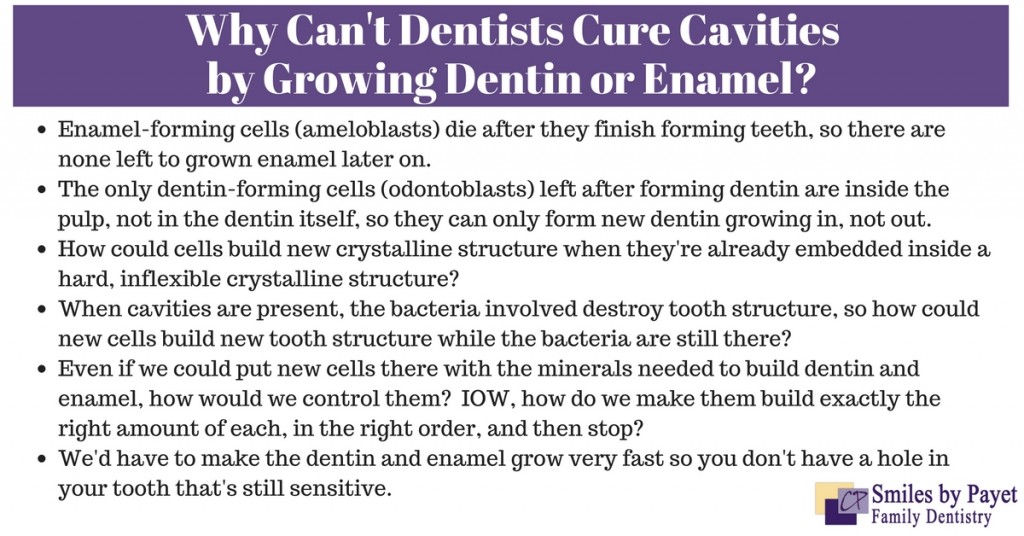
I've previously discussed why you can't cure cavities, but recent research sounds promising, so it's a good time to review.  In addition, there were some good points raised in the comments of the previous article that deserve more attention.  Be warned: lots of bullet lists ahead as I break it down.  :-D Recap: Why We Currently Can't Grow Dentin or Enamel A small-looking cavity that was actually quite big, cleaned out with a laser and filled with composite resin. You can't cure cavities like this. Let's briefly summarise the difficulties that must be overcome in order to cure cavities, whether naturally or artificially: Once the cells that form dentin (odontoblasts) and enamel (ameloblasts) finish forming teeth, they die.  Some odontoblasts remain in the tooth pulp, but they are stuck inside and can't get out. We currently have no way to grow and transfer dentin- or enamel-forming cells into a tooth with a cavity and survive, much less grow new tooth structure. The dentin-forming cells in the pulp can't grow outwards, just inwards, which shrinks the pulp chamber.  This is a normal response to stress from cavities, bruxism, trauma, and aging. If you already have a cavity, we still have to get rid of the bacteria, which usually means drilling out the infected tooth structure. If we don't want to drill, but just put a miracle gel on the tooth, it has to do 3 things: Stay in place for a long enough time to strengthen the enamel and soak way in for deep cavities It has to kill the bacteria inside the cavity It can't negatively affect the rest of your mouth. If we have to drill out the cavity, then place the miracle gel, we still [...]

“If You Don’t Floss, You’ll Die,” Says One Charlotte Dentist

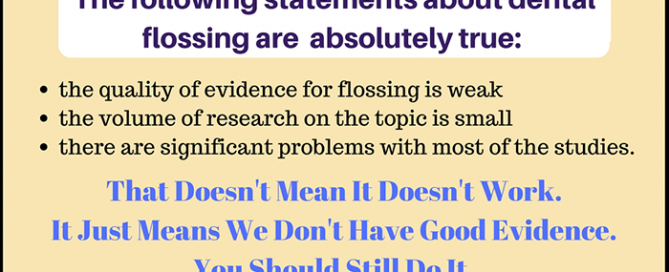
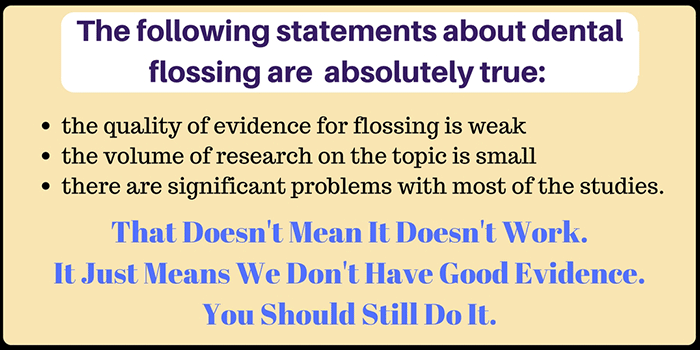
Oh ok, sue me for the clickbait headline....you'll die if you do floss, too.  :-D The Story: Does Flossing Even Work? Obviously, since I'm a dentist and have many dentists friends, one of the most commonly shared and widely discussed news stories this week has been about whether or not flossing is any good for you.  Naturally, because science journalists need traffic for their websites, too, there have been plenty of outrageous headlines: It all started with this Associated Press story: Medical Benefits of Floss Unproven Wait, Does Dental Floss Even Work? (Gizmodo) No Need to Floss, US Health Department Says (NY Daily News) Feeling Guilty about Not Flossing? Maybe There's No Need (The NY Times) And naturally, just as I've discussed in a number of other articles over the years, the science journalists have taken a story about the weak scientific evidence for flossing and suddenly turned it into "OMG FLOSSING IS USELESS!! DENTISTS HAVE BEEN LYING TO US FOR DECADES!!!!"       Ummmmm........no. Just......no.  /facepalm/       The Real Story: There Truly Isn't Much Good Research So here's the crux of the story as quoted from the Associated Press report that set the storm in motion: The AP looked at the most rigorous research conducted over the past decade, focusing on 25 studies that generally compared the use of a toothbrush with the combination of toothbrushes and floss. The findings? The evidence for flossing is "weak, very unreliable," of "very low" quality, and carries "a moderate to large potential for bias." Let me be perfectly up front and honest here, because I have to be, given how much I've harped on the importance of critically evaluating and understanding scientific research and [...]

By | 2017-06-09T20:28:43-04:00 August 3rd, 2016|Cavities, Gingivitis, Taking Care of Your Teeth|0 Comments

Replacing Veneers after 15 Years

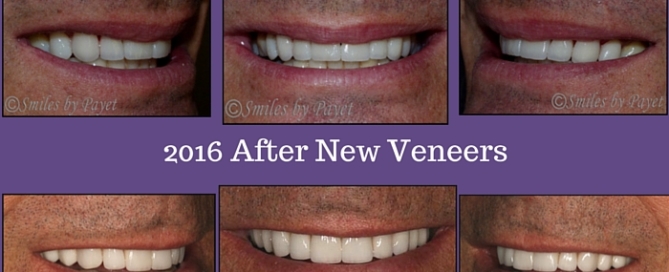
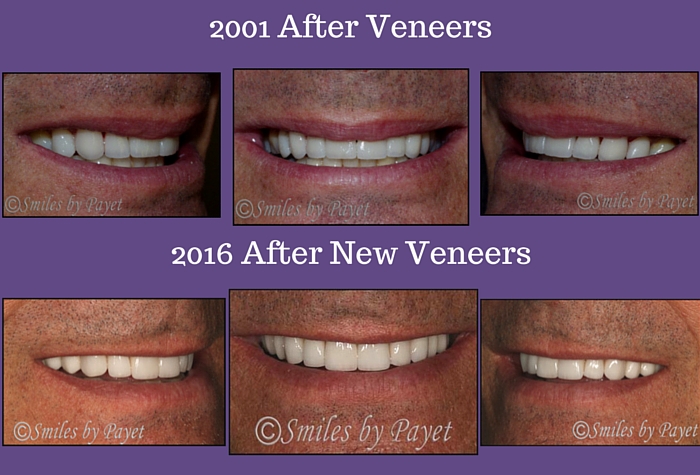
There are a number of important questions to ask when considering cosmetic dentistry, including porcelain veneers: How many veneers do I need? What can (and can't) you change about my smile with veneers? When are veneers better than braces? How much do veneers cost? How long do veneers last and what happens when they need replacing? Recently, we saw a patient for whom I did 8 porcelain veneers in 2001, and his case illustrates all of these questions, so without further ado, let me introduce Steve's teeth.  (He's a rather private person and prefers not having his portrait used, and this is something that we always respect.) Please forgive the varying levels of photography you see through this article; the first photos were originally slide film that were scanned from negatives, then they move through a series of progressively better cameras and a progressively improving photographer (me). :-)  I've tried to even them out with Photoshop, but rest assured, absolutely nothing else has been done to the photos. 8 Porcelain Veneers in 2001 Steve originally came to us because he was getting ready to attend a big high school reunion, if I recall correctly.  It was on kind of short notice, too, as in he was catching a flight the next day.  Yikes!  But we arranged to see him later that day and started him on 8 veneers to lengthen his worn-down teeth.  He looked pretty good with the temporary veneers for the reunion, and we saw him a few weeks later to bond in the real porcelain veneers.  So back in 2001, the first set of 8 veneers took Steve's smile from here: Fast Forward to August 2015 & 2 Cracked Veneers Given that Steve [...]

Dental Cavities: How Fast Can They Grow?

How fast dental cavities grow may sound like a simple question, but it's actually rather complicated.  I decided to write about it, though, after seeing a patient recently to treat a cavity that went from just beginning to an almost-root-canal-sized cavity in just 14 months.  It's a good example of why most dentists still recommend dental bitewing x-rays every 12-18 months. Is the Cavity There or Not? Here's the starting x-ray, taken on Dec. 14, 2014.  If you look at the circled area, it looks fairly normal.  Unfortunately, there was a slight overlap of the teeth in the x-ray, as the digital sensor was angled ever-so-slightly, and the overlap may have masked the area of concern, preventing an earlier diagnosis.  Since the patient had few fillings, though, indicated a low risk of cavities overall, we didn't retake the x-ray to avoid unnecessary exposure.  Nevertheless, there's really nothing there that caused me any concern. 14 Months Later, the Cavity is Obvious & Deep Check out the circled area this time, eh?  I've outlined the nerve chamber in the tooth on the x-ray in red and the cavity in green, but it's important to know that a cavity is never sharply defined like this.  There are several zones identifiable in cavities, highlighted in the next image.  We also know that cavities are typically about 20-30% bigger than can be seen on an x-ray, which is due to 2 reasons: The human eye can only distinguish about 60% of the shades of grey as a computer monitor can project, so there is simply detail that the eye can't detect, and The deepest zone of decay has not yet softened enough to be less dense enough for x-rays to detect it, [...]

2015: A Review of this Charlotte Dentist’s Blogs

Back in 2014, I was kind of a blogging machine, with 29 total blog articles published that year.  In 2015, partially due to some neck/shoulder problems, I wasn't able to write nearly as much, as I had to stay away from the keyboard for several months, but I still did publish 15 total articles.  Five of those were minor office announcements, but 10 of them were quite in-depth and took a heck of a lot of work. That's the other reason I didn't write as prolifically, because each article took much longer to research, fact-check, and verify. Thanks to some networking and connecting with people in the science, nutrition, farming, medicine, and skeptical communities, my posts in 2015 were read by a tremendously larger audience, and I'm very grateful to all the people who helped spread the word. Best Dental Blog Posts of 2015 ➣ Fluoride is Safe and Effective: after reading way too many BS articles about the alleged dangers of fluoride, I knew it was time to write an in-depth article on just how safe and effective it is at preventing cavities.  All that crap thrown around by anti-fluoridationists is just that - crap.  Every single claim they've ever made has been thoroughly debunked and shown to be false.  I do review changed AAP Guidelines, too. ➣ Water Fluoridation Does NOT Increase ADHD: this was in response to a BS article in Newsweek by an anti-fluoride journalist (Newsweek should be ashamed) about a totally crappy study that absolutely didn't prove any connection between ADHD and water fluoridation. I took this one personally, since I'm also ADD.  And while I'm at it, I should mention that French kids DO have ADHD - I'm French.  That editorial [...]

I Love Sugar & Bacon

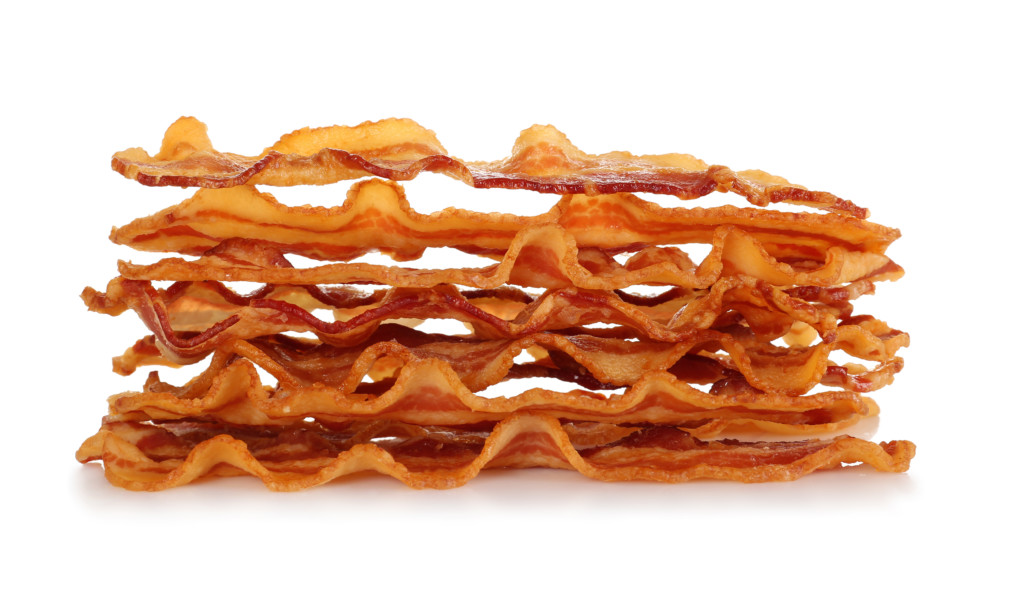
In the last month there have been articles running wild in the news and on social media on 2 subjects that are driving me nuts with how the journalism is misrepresenting or badly overblowing the results.  And I just can't let it go because - well, danggit, they're going after 2 of my favorite things!  And yes, we're talking about sugar and bacon.  Seriously, y'all.......do not mess with sugar and bacon unless you've got really AMAZING evidence.  Which these studies don't.  So if you are like me and you enjoy sugar in your coffee or tea and you enjoy some bacon, deli meats, and steak, it's ok - keep enjoying them!  But if you're having to argue with your husband or wife about why you still eat bacon and use sugar in your coffee, here's the ammo you need.  (Please thank me with market style bacon from Fresh Market, ok?  :-) I've written about how bad science journalism can be in some previous articles that you can read here: 10 Simple Truths about Food Bad Reporting on Fluoride by Newsweek Fluoride does NOT increase ADHD Why I Don't Buy Organic Food Anymore Bad Science Reporting #1: Sugar, Kids, and Health Improvements First of all, let me be clear that, as a dentist, I am firmly of the opinion that it's a good idea to limit your sugar intake because excess sugar is bad for your teeth and your overall health.  Glucose, fructose, sucrose, it doesn't matter.  Too much of it is bad for you.  Even if it's in "healthy juices!"  I don't think that any reasonable person would disagree with that.  Where I DO have a problem, though, is when people exaggerate the effects of sugar, [...]

By | 2018-02-15T20:56:12-05:00 November 12th, 2015|Health & Food, Taking Care of Your Teeth|0 Comments