



Gingivitis

Does Gum Disease Cause Heart Attacks & Strokes?

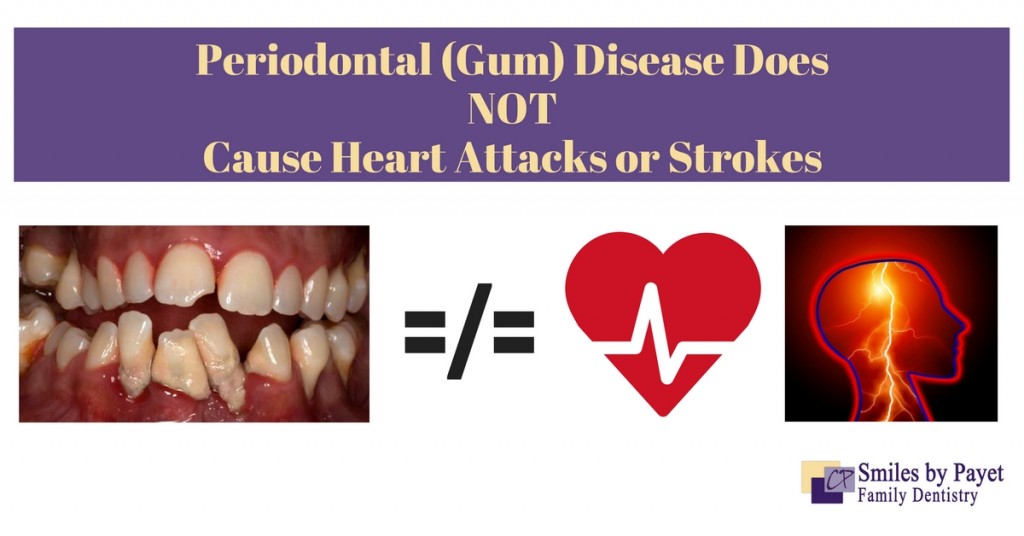
I was recently reminded of claims that periodontal disease is associated with medical conditions like heart attacks, strokes, pre-term births, and diabetes.  Yes, there is an association among those conditions, that's true.  However, some dentists and hygienists try to scare patients into treatment by claiming that gum disease actually causes those conditions.  That's simply not true! One of the most recent articles touching on this touchy subject was by Dr. Chris Kammer, titled “Your Gums are a Cesspool of Infection...and Most Dentists Don’t Care!” as a blog article for the American Academy for Oral Systemic Health; an organization that he coincidentally co-founded in 2010.  The entire purpose of this organization, incidentally, is based on the idea that oral disease (primarily periodontal disease) has significant links to disease in the rest of the body. This link between the oral cavity and the rest of the body was first hypothesized and published in 1989 in two Scandinavian reports (Mattila et al in the BMJ, and Syrjanen et al in the J. Inter. Med) and studies continue to this day.  To this day, however, the results are simply not strong enough to make claims about causality. Correlation Still Doesn't Equal Causation Just as I've criticized holistic and alternative medicine and dentistry as junk, it's crucial that dentists be honest about the level of evidence for anything that we recommend - even flossing!  When we see things that seem to be connected, like gum disease seems to be connected with heart attacks and strokes, we have to ask: is it correlation (coincidental), or is it actually causal (one thing directly leads to the other).  Yes, there seems to be a strong correlation between gum disease and heart attacks and strokes, [...]
“If You Don’t Floss, You’ll Die,” Says One Charlotte Dentist

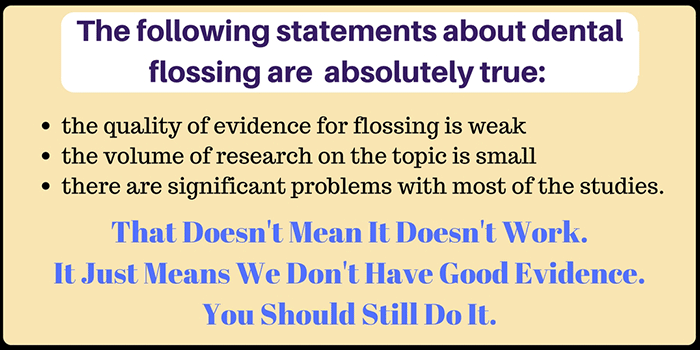
Oh ok, sue me for the clickbait headline....you'll die if you do floss, too.  :-D The Story: Does Flossing Even Work? Obviously, since I'm a dentist and have many dentists friends, one of the most commonly shared and widely discussed news stories this week has been about whether or not flossing is any good for you.  Naturally, because science journalists need traffic for their websites, too, there have been plenty of outrageous headlines: It all started with this Associated Press story: Medical Benefits of Floss Unproven Wait, Does Dental Floss Even Work? (Gizmodo) No Need to Floss, US Health Department Says (NY Daily News) Feeling Guilty about Not Flossing? Maybe There's No Need (The NY Times) And naturally, just as I've discussed in a number of other articles over the years, the science journalists have taken a story about the weak scientific evidence for flossing and suddenly turned it into "OMG FLOSSING IS USELESS!! DENTISTS HAVE BEEN LYING TO US FOR DECADES!!!!"       Ummmmm........no. Just......no.  /facepalm/       The Real Story: There Truly Isn't Much Good Research So here's the crux of the story as quoted from the Associated Press report that set the storm in motion: The AP looked at the most rigorous research conducted over the past decade, focusing on 25 studies that generally compared the use of a toothbrush with the combination of toothbrushes and floss. The findings? The evidence for flossing is "weak, very unreliable," of "very low" quality, and carries "a moderate to large potential for bias." Let me be perfectly up front and honest here, because I have to be, given how much I've harped on the importance of critically evaluating and understanding scientific research and [...]

By | 2017-06-09T20:28:43-04:00 August 3rd, 2016|Cavities, Gingivitis, Taking Care of Your Teeth|0 Comments

Crowns Shouldn’t Make Gums Bleed

One thing that patients can't stand, and understandably so, is getting a crown done, and after it's put on, the gum around the crown turns red, sore, and it bleeds easily when brushing and flossing.  After all, a crown should FIX a problem, not create one, right? Why Do Some Crowns Make the Gums Red and Bleeding? There are some important rules dentists must follow when doing crowns: Make sure the lab (or CEREC Same Day Crown System, as in our case) has a crisp, clear edge so the fit of the crown is accurate; Make sure the tooth is dry and not contaminated with blood, saliva, or water when the crown is cemented or bonded; Make sure the final crown is the right size for the tooth; i.e. that it is not too bulky; Make sure the edge of the crown is not too close to the bone, or it violates the "Biologic Width." Reason #4 is the most common reason for crowns to end up causing red, bleeding, and sore gums, but for patients, it is a harder to understand why, and why some minor gum surgery is really an easy and long-term fix to avoid an aggravating problem. What is Biologic Width, and Should You Care? Basically, you need a minimum distance between the edge of a crown and the bone.  For most patients, for most teeth, it's about 3mm.  Sometimes a bit more, sometimes a bit less. Now, if you put the edge of a crown closer than 3mm, your body doesn't like it; it becomes a "foreign body," and your immune system is triggered, thinking that it needs to get rid of that foreign body.  Naturally, it can't, but that [...]

By | 2017-06-09T20:35:04-04:00 August 26th, 2012|Gingivitis|0 Comments

Drug for Osteoporosis May Help Treat Gum Disease

It's fascinating to see the kinds of studies that are being done by different universities and drug companies, because sometimes you get a rather unexpected result.  In this case, researchers at the University of Michigan found that a drug made by Eli Lily, Forteo (generic name teriparatide) seems to actually help regenerate bone in jaws that was lost due to gum disease.  The really cool thing is that the regenerative effect seems to continue for some time after the patient even stops taking the drug.  What a wonderful additional tool this would be in our efforts to reverse bone loss and save teeth!  Now, one should not take the message away that you would not need to keep seeing your dentist regularly and have the appropriate dental treatments for periodontitis, but if you're making the effort to brush and floss regularly, use antibiotic mouthwashes, and get either Scaling/Root Planing (aka "Deep Cleaning") or LANAP (aka Laser Periodontal TherapyTM), then adding yet another treatment would be even more beneficial.  Read on for more details: Osteoporosis drug heals bone wounds in gum disease patients 20. October 2010 03:05 A drug marketed to grow bone in osteoporosis patients also works to heal bone wounds in gum disease patients, a University of Michigan study suggests. "This new approach for the treatment of periodontal disease could allow us to rebuild some of the bone that is lost due to periodontal disease, which until this point has been very difficult to achieve," said Jill Bashutski, clinical assistant professor at the U-M School of Dentistry and first author on the study. "Current treatments to re-grow bone around teeth affected with gum disease have limited success rates." The findings are significant because gum [...]

What’s the difference between Gingivitis and Periodontal Disease?

This is one of those simple questions that can seem quite confusing to the public, because most dental offices don't do an adequate job explaining the difference, and sadly, periodontal disease is still one of the most under-diagnosed and under-treated diseases in the United States.  Part of the reason for the lack of treatment does come from the lack of proper diagnosis, but the other part is most commonly that patients believe that treatment for periodontal disease is too uncomfortable or that it doesn't seem to work very well.  Fortunately, we now have a genuine treatment that both works and is comfortable: Laser Periodontal TherapyTM.  Still, it is important to understand the difference, so you can know if you do or don't have either gingivitis or periodontal disease, and what you can do about it. Gingivitis In the simplest terms, Gingivitis is inflammation of the gums, caused by a build-up of plaque around the teeth that is not completely and regularly cleaned by good brushing and flossing. You could think of it as a paper cut on your skin -- you know, it gets really red and irritated and sore, will bleed a bit, but if you take good care of it by putting ointment on and a bandaid (the equivalent of good brushing and flossing), it will go away quickly. What do you need to do to cure gingivitis? Brushing at least twice/day Flossing at least once, preferably twice/day, with good technique, and possibly Using a non-alcohol-based, fluoride mouthrinse. If left untreated, gingivitis can progress to become periodontal disease if there are other contributing factors, but it does not automatically do so, and it can be reversed with improved care of your teeth and [...]