





Grinding and Clenching are 2 dental problems that result in jaw pain, teeth wearing down, teeth cracking and breaking and chipping. They are connected to TMJ disorders, as well as migraine and tension headaches, and can be treated with the NTI-tss, which stops grinding and clenching of the teeth.

Facts & Myths about TMD, TMJ, & Orofacial Pain
In dentistry as in medicine, you'll find doctors on every side of contentious issues: is the mercury in amalgam dental fillings safe or not? (Yes, the science is clear that it’s safe). Is fluoride beneficial or dangerous? (Again, the science is solidly on the side of safety and efficacy). While dentists argue about which bonding agent or porcelain is best, one topic is almost guaranteed to cause huge fights: Occlusion and TMJ/TMD, if they're connected or not, and even their basic definitions. If our profession can't even agree, it’s no wonder that the public knows so little of what causes TMD, what can be done to treat it by dentists, when one should be evaluated or treated by other medical specialists, what medications help and which don’t. Hopefully this article can help clear up some of the myths & misinformation. This article was co-written with Dr. Rich Hirschinger, an Orofacial Pain Specialist in California, and was first published in April 2017 in Massage & Fitness Magazine Winter 2017 edition. “My Last Dentist Told Me I Have TMJ” Whenever I hear this comment, I have to chuckle, because I sure hope they do! After all, “TMJ” simply means Temporomandibular Joint and refers to the joint where the uppermost part (the condyle) of your lower jaw (mandible) moves against the temporal bone at base of your skull. After all, you don’t go to the knee specialist and say, “I have knee.” What people really mean is that they have one or more signs and/or symptoms that fall under the broad term of Temporomandibular Disorders, or TMD. For most people, they think of these kinds of conditions: They clench or grind their teeth. They have pain in their [...]
Do You Need a Crown on a Cracked Tooth?
We recently had a new patient see us with no tooth complaints, she just needed a check up and wanted to discuss her headaches to see if we could help. During her exam, I noticed that several of her molars were severely worn down (which she already knew about) and had cracks visible. We didn’t take photos at her appointment (should have!) to show her, but she seemed comfortable with my recommendation of doing crowns on those 4 teeth to catch and contain the cracks before the teeth break. Since she decided on a second opinion for those teeth, which I fully respect, I decided this is a good opportunity to review cracks in teeth, and what (if anything) to do about them. Tooth Cracks Don’t Show Up on X-Rays One difficulty with diagnosing cracks in teeth, is that they almost never show up on x-rays. Why, you ask? Good question! It’s because x-rays are traveling perpendicular to the cracks, and the cracks are so narrow, there’s not enough change in the tooth density for the x-rays to show it. To show up on an x-ray, a crack in a tooth would have to be so wide, you could stick a fork in it, and then you’d already know there was a problem. The x-ray shown here is from another patient we recently treated, and while you can’t see anything on the x-ray, want until you see how it looked inside the tooth (on below). […]
How Do I Know You Grind Your Teeth, Even if You Don’t Believe Me?
I don’t know why exactly, but patients at my Charlotte dentist office (and all around the country, according to my colleagues) seem to have a problem believing me when I say, “Wow – you grind your teeth really badly.” In fact, the most common response is, “No I don’t!” said with a passion that makes it seem I’m accusing them of killing baby animals. Seriously – and there are a few reasons why people think they’re right and I’m wrong……..even though I’m the doctor. Weird, huh? […]
Our Convenient Dental Office
Have you ever gone to the dentist for a problem, only to learn that you were going to have to see 1 or even several specialists to get all your treatment done? It's a bit irritating and inconvenient, isn't it? Even having to make appointments at the dentist and the orthodontist to get a cleaning and then braces means multiple trips, the doctors are (hopefully) communicating to make sure your treatment runs smoothly, etc. Certainly, this can be done very successfully, and I'm fortunate to work with some great specialists myself, but it's still a bit inconvenient, don't you think? Specialist-Level Dentistry in Charlotte NC Dental Office Just to be perfectly clear (gotta comply with state regulations, of course): I am a "General" dentist. What does that mean, really? Well, it means that I am allowed to perform pretty much every dental procedure of which I'm capable, unlike a dental specialist, at least in North Carolina, where regulations limit them to the area of their specialty. The catch is this: if I offer a procedure usually done by a specialist, i.e. an orthodontist, endodontist, periodontist, etc., I have to make sure I can do it as well as that specialist can do it. Of course, that requires that I really know my stuff! Now, given that I am a serious dental geek, there are several reasons I offer and perform a wide variety of procedures: I absolutely love learning and getting better at what I do; I like having total control over the outcome; Patients appreciate convenience and getting everything done in 1 place. How Many Services Do We Offer? Now, if you browse our website, you can read all this, but let me summarize [...]
Do You Need a Dental Root Canal?
Of all dental procedures, a root canal is probably one more dreaded by patients than any other, because practically everyone has heard some nightmare story about them. Remarkably, though, with proper diagnosis and management, the need for root canals can largely be avoided, and in cases where they are needed, they are virtually never painful, either during or after the procedure! There is so much misinformation out there, though, that it seems appropriate to provide some answers to those Frequently Asked Questions about Dental Toothaches & Root Canals: What is a Root Canal, and Why Might You Need One? There are several possible reasons you might need a root canal, including: A large cavity that reaches the nerve, resulting in pulpal infection Part of the tooth breaks due to trauma The tooth cracks due to grinding or clenching your teeth Tooth resorption Essentially, what happens during a root canal is that we remove the infected, painful nerve tissue from inside the tooth, clean the area with several disinfecting solutions, which also help remove debris, then seal the inside of the roots with a cement and a special form of rubber called gutta percha. There are several variations on the technique and sealers, but they all do the same basic thing. Does a Root Canal Hurt? In the large majority of cases, once the tooth is numbed, the answer is NO, you should NOT experience pain during the procedure. If you do, please signal your dentist that you are still feeling the procedure. Sometimes, a tooth is so badly infected that your face may swell up. In these cases, the infection is severe enough that it will decrease the numbing's effectiveness, and you may just need [...]
My Tooth is All Cracked Up!
The Value of a Nightguard to Protect Teeth It's been quite some time since I talked about how important a nightguard can be to protect teeth and decrease the risk of major problems that can cost a lot to fix. Personally, I think it's a little on the ironic side when someone tells me, "Doc, I can't afford the $200 for a nightguard." because I know that they will end up paying me a lot more than that when teeth break and crack. Here's yet another example of why you should get a nightguard if you grind/clench your teeth: If you are concerned about your teeth cracking and would like to protect them with a nightguard, or to find out if any of your teeth may be in this condition, or even just to find out if you do grind/clench your teeth (and no, just because your partner doesn't hear you does NOT mean anything, trust me!), please call 704-364-7069 or Request an Appointment Online. This is a great time of year to get something done and to take advantage of any remaining dental insurance benefits before you lose them on 12/31.
Sleep apnea tied to increased risk of stroke; Even mild sleep apnea puts men in danger, study finds
Sleep apnea tied to increased risk of stroke; Even mild sleep apnea puts men in danger, study finds. Here is a topic that is so incredibly important for all men (and women), because it is still so underdiagnosed. Even more importantly, few patients know that your DENTIST may be able to help treat both snoring and sleep apnea with some oral appliance therapy, such as those found on the www.ihatecpap.com website. Another great resource is the www.SnoringIsntSexy.com website and blog, written by a friend and colleague Dr. Larry Barsh. I'm including a couple self-tests/questionnaires here, courtesy of Dr. Barsh. Watermark ARES Questionnaire (you'll need the Adobe Acrobat Reader - click here to download for free) Snoring and Sleep Apnea Self-awareness Toolkit The take-away message here is loud and clear: Snoring and/or sleep apnea are a major health problem; don't ignore them, or you could literally be cutting your life short.
Dr. Oz talks about Periodontal (Gum) Disease and Total Health
I guess it's because I don't watch a lot of TV, but I confess that - until quite recently - I had absolutely no idea who this guy Dr. Oz is. A friend recently told me that Dr. Oz has some really good material about dental health that can be shared, and since it's sometimes easier to use someone else's material instead of having to write it all from scratch myself :-) , I figured I'd check it out, and WOW! I'm impressed! It's sad to say, but many physicians really have no idea about how the health of the mouth is connected to the rest of the body, and how valuable their dental colleagues can be in diagnosing a number of medical conditions. Dr. Oz is definitely not one of them! I'll kick things off here with one of his articles. I have added some bold italics for emphasis (all mine). [...]
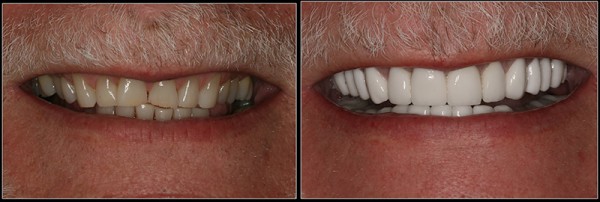
Complete Smile Makeover with Porcelain Crowns
A Full-Mouth Smile Reconstruction Quite some time ago, I showed this case as an example of how badly teeth can be damaged by grinding them, whether at night, in the daytime, or both, and why something as simple and inexpensive as a nightguard (my recommendation is a NTI-tss). It is especially inexpensive in comparison to the cost of rebuilding a smile that is so broken down. This gentleman came to us in 2008, looking for options to feel good about his smile again for various reasons. After plenty of discussion, we agreed that the only option that would truly give him the smile that he wanted was a Total Smile Makeover/Reconstruction with porcelain crowns. After showing the Before-After pictures of his smile, I'll discuss some of the issues you need to consider if you are thinking about significant cosmetic dentistry for yourself. Frequently Asked Questions about Smile Reconstruction When rebuilding a smile such as this, it is crucial to establish a proper bite relationship of the top and bottom teeth. Sometimes this can take a little while to figure out, because - when the teeth are so worn, the patient has long since adapted to a very bad bite relationship. The muscles have to be relaxed, accurate records taken, and excellent communication is necessary among the patient, the doctor, and the lab, to ensure that the crowns are made to look good, feel good, and last a long time. However, in severe wear cases, we always remind the patient that s/he already did a pretty good job destroying their natural set of teeth, so a nightguard is an absolute requirement as "insurance" to protect their investment, and even then they are more likely to break [...]
News segment with Terrie Reeves & Dr. Payet on "Train for Life", on TVNews 14 in Charlotte – coming soon!
Earlier this year, I had the pleasure of recording a short interview with the Founder and President (and one of my patients) of the Wellness Coalition of America, Ms. Terrie Reeves, for her weekly segment on TVNews 14 (every Sunday) called "Train for Life." Each week, Terrie interviews people in different areas of life, all of which are somehow related to our total health and well-being. My first interview was how dentists can be an important part of your health-care team, because many diseases can be diagnosed through various conditions that come up in the mouth - diabetes, leukemia, gum disease - especially this one, because it has been shown to be linked to an increased risk of heart disease, stroke, and more. You can see the video segment that was aired in late spring 2009 at this link: Dental Health and Total Body Health Links (please note that the video must be viewed on Internet Explorer or Safari, but does not play on Firefox - sorry!). Well, today we'll be recording 2 new segments to be aired this fall. The first will be on the NTI-tss, an FDA-approved and non-medication treatment for Chronic Migraine and Chronic Tension Headaches, and the second spot (won't air until November) will cover the most effective and comfortable treatment for periodontal (gum) disease available: the LANAP (Laser Assisted New Attachment Procedure) protocol, which can only be performed by a dentist licensed in the use of the Periolase MVP-7 free-running pulsed Nd:YAG dental laser. I'll be sure to post links to each of these as they become available! I must admit, it's kind of fun to become a local expert on dentistry for the media. :-)


